

How tech’s most craft-obsessed team uses AI: Inside design at Linear
"When you can do anything, what you choose not to do is far more important than doing everything much faster."

In our first AI in Design case study, we explored how Sierra uses AI to build better customer experiences. Today, we’re taking a look inside one of the most craft-focused teams in tech, and how their own design process is evolving in the age of AI.
“Design is a search, not a production pipeline”: How Linear protects the thinking behind great software
Linear is the product development system used by more than 40,000 teams, including OpenAI, Coinbase, and Ramp. Known for its obsessive attention to detail, the company has become a benchmark for software craftsmanship. Ask a room full of product designers which company builds the best-designed software, and Linear is almost certain to come up.
Charlie Aufmann, who started at Linear as a product designer late last year, says he felt intimidated in joining the team: “This is one of the best design teams in the world and the craft is through the roof…will I meet the craft bar?”
That bar gets harder to maintain when anyone can turn an idea into working software in seconds. It gets tempting to skip the messy thinking, iteration, and judgment required to design great products. But even as Linear’s own product has evolved toward an increasingly agentic future, the team is extremely intentional about how it uses AI - not to opt for speed at all costs, but to deliberately create more space for human judgment.
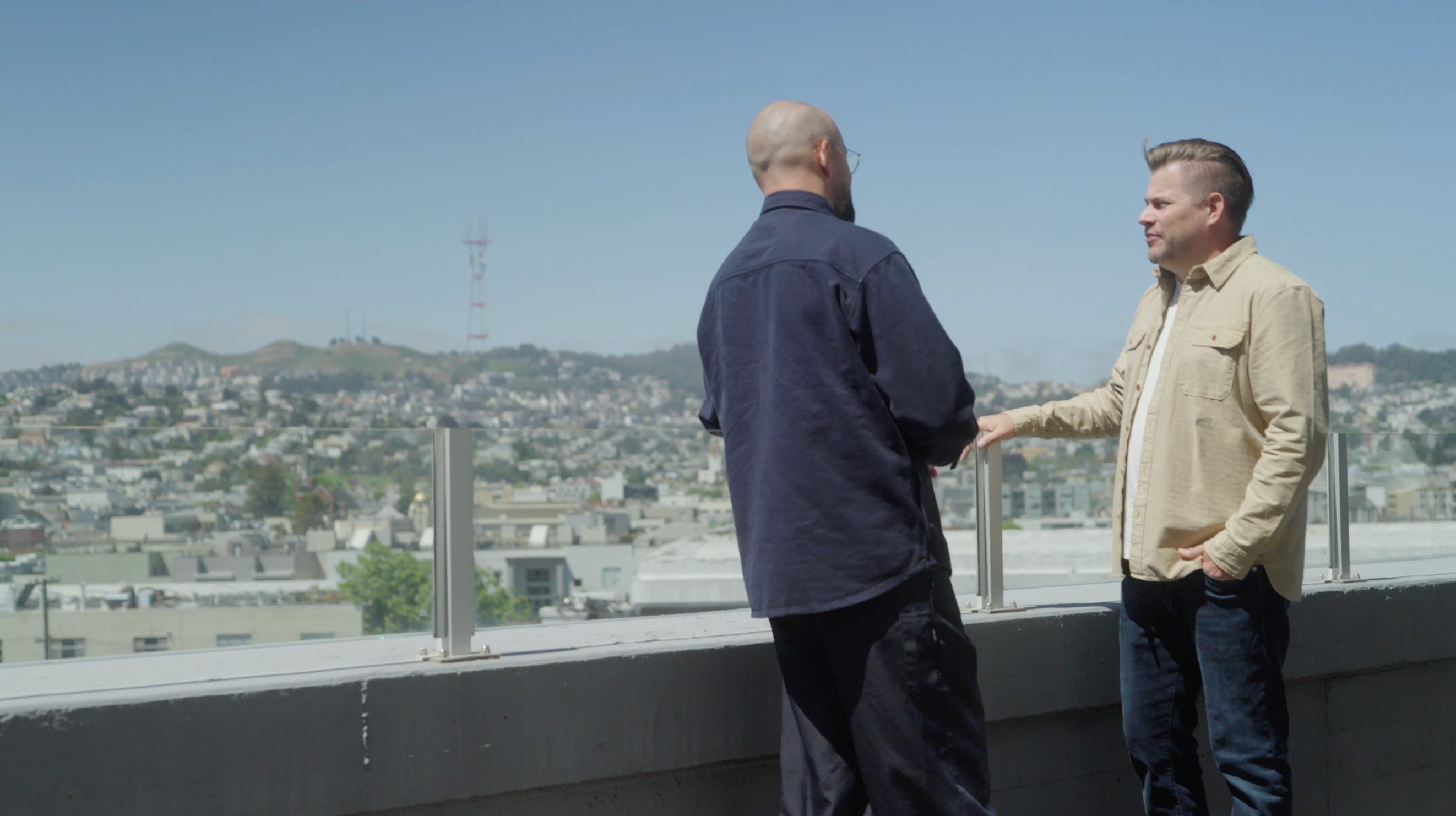
We sat down with Linear’s CEO Karri Saarinen and product designers Charlie Aufmann and Isha Kumar to understand how their design philosophy and way of working translate to an AI world.
What you’ll learn:
How Karri built an AI skill trained on how Linear thinks
How designers use agents to pull customer and product context
Why one designer uses AI for only a quarter of new design work
Why you shouldn’t skip the problem phase
Somewhere over the last couple of years, the conversation shifted from “should designers code?” to “how much should designers code now that AI makes it so easy?” As our own research reflects, half of designers now say they ship code to production.
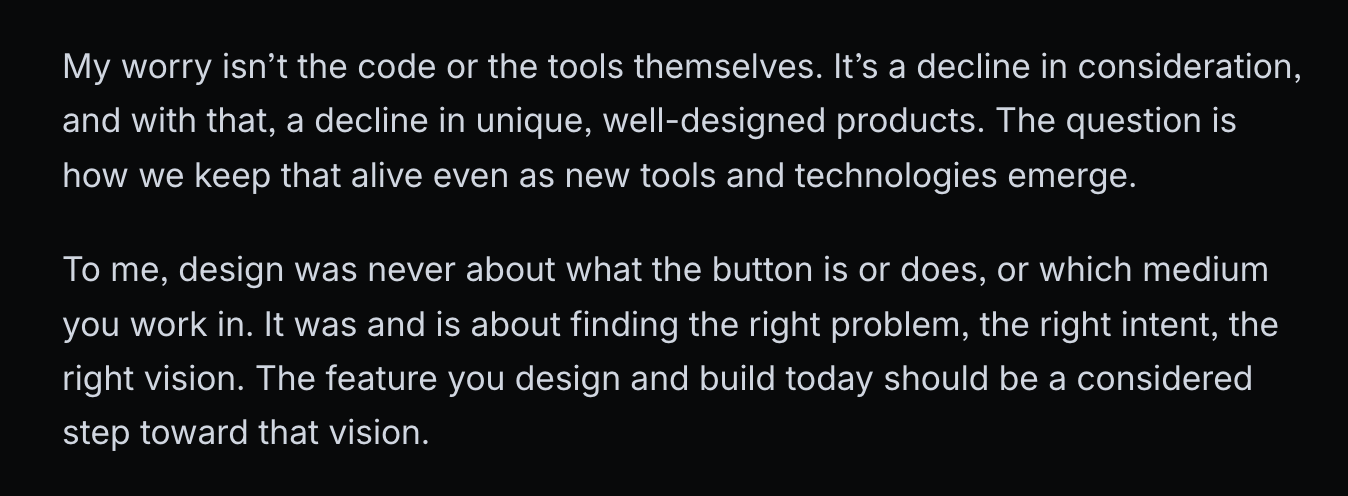
Karri worries about what gets lost when this becomes the default way of working. It’s not that designers coding is inherently bad, but that code, as a medium, tends to force commitment. Turn a half-baked idea into a working prototype with one prompt, and you can find yourself boxed in by technical constraints before you've had the chance to figure out what problem you're actually solving.
He views design as a search: you start with a messy problem without knowing the final answer. The mistake is skipping that search entirely, or failing to get clarity on the problem in the first place.
He sees this as one of the most common reasons design projects fail:
“People won’t agree on solutions, because they have different problems in mind. The solution becomes a compromise of many different problems, instead of a clean solution to one.”
For Linear, this is why preserving that process of deep consideration and problem exploration is essential to creating great products.
Use AI to interrogate the problem
Karri built /linear-way, a custom AI skill trained on Linear’s blog posts and other internal materials. Connected to a repository of over 40k+ customer requests from customer calls, Intercom emails, Slack messages, and tweets, the skill acts as a sounding board.
Customers typically ask for specific solutions (“I want this feature”) rather than describing the underlying pain point. So Karri uses the skill to interrogate the request:
What need is behind this request?
What assumptions are we making?
What happens if we don’t build this?
The skill is explicitly designed not to simply accept a request at face value:
“Act like a Linear product teammate, not a request-taking assistant. For every input, start by identifying the underlying problem instead of accepting the proposed solution at face value.”
When Linear was considering whether to build a wiki feature, for example, the skill helped uncover that customers weren’t really asking for a full knowledge base inside Linear. They wanted an easier way to keep and access team documents where their work already lived.
The agent had reframed the problem: “The ask is less please improve docs and more please let context live where execution lives.”
Karri then pushed it further: why shouldn’t Linear build the feature? The agent argued that the idea could dilute Linear’s core strength, bloat the product’s scope, and pull the company into the crowded knowledge-base category. Instead of simply validating the idea, AI helped Karri pressure-test it. Watch the full /linear-way demo.
Gather the context needed for better decision-making
Product Designer Isha Kumar uses AI similarly, long before touching code.
When fixing a bug in how issues linked to active developer sessions, she first tasked an agent with querying the codebase and historical decision logs to explain why the legacy behavior existed. “I just need it to aggregate context so I can make an informed decision.”
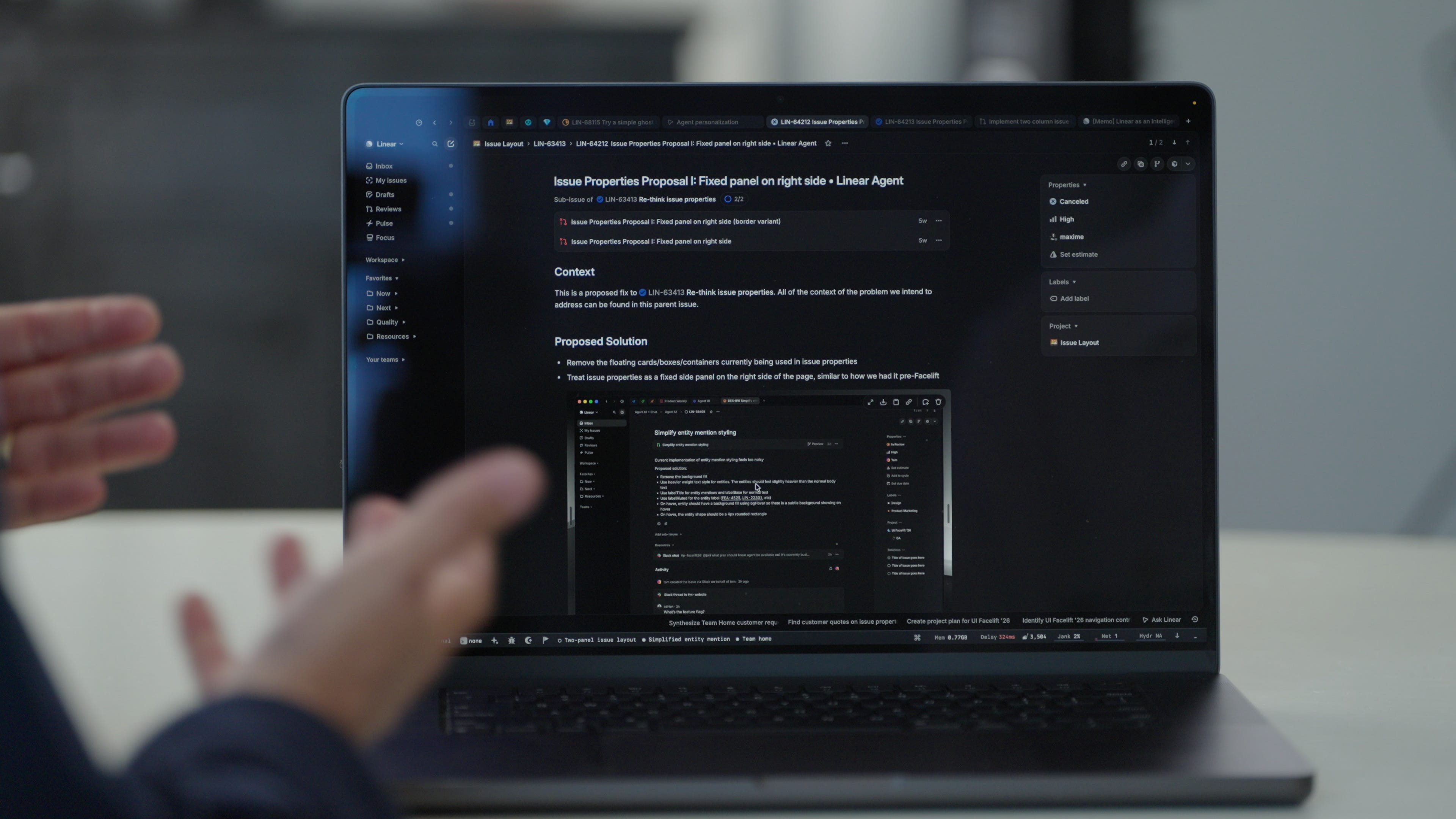
Charlie took this approach to a macro level during Linear’s interface refresh earlier this year. When customers pushed back on a new issue-page layout, he used an agent to pull together the customer quotes across Twitter, Slack, and customer calls, to “feel into what truly is the problem here that needs to be solved.”
Then during design review, he brought that synthesis in alongside before-and-after screenshots, so the team could make decisions based on raw customer quotes instead of his personal take.
In both cases, AI helped surface the information needed to make a better decision.
Protect the creative process
AI has dramatically expanded what designers can build. But for Isha, it introduced a different question: which parts of design are worth protecting?
When she first leaned heavily on AI, she noticed her process degrading. Chat interfaces forced her to translate visual, subconscious instincts into text prompts, interrupting her flow. Managing the tool began to feel like overseeing “a team of junior employees” rather than designing.
So she chose to use AI where it removes friction, rather than across her entire workflow. Today, that means fixing UI paper cuts and quickly building dynamic prototypes for edge cases that were once tedious to explore. It fits naturally into Linear’s Quality Wednesdays, a weekly ritual where the team comes together to fix the small imperfections that, over time, can degrade the overall product experience.
She doesn’t use AI to critique her designs or write her UI copy. “It wants to affirm me, not provoke me,” she says. “AI-generated language really does feel like I’m settling.” Only about 20-30% of her net-new design work runs through AI, while the rest remains hands-on.
“There’s a big difference between using something as a tool and using it as a crutch. AI invites infinite usage, which can make you trust yourself less. If AI is the only tool you reach for, it reveals blind spots in your own craft.”
- Isha Kumar, Product Designer
Here are a few practical principles from the Linear team on using AI without outsourcing your thinking:
Gather context, not opinions. “I ask questions where I don’t really need its opinion,” says Isha. “I just need it to aggregate context so I can make a decision.”
Make AI argue against you. The agent wants to please you, so Karri makes it disagree with him: “I ask it to make the argument against my thinking, and I evaluate that; are those arguments good, should I take them seriously?”
Define what good looks like before you build. AI can make almost any output feel like progress, which makes it easy to rationalize whatever you get back. “Otherwise, you always succeed. It can never fail, because you never set any criteria,” says Karri.
Learn while you build. Charlie tells the agent up front to teach him: “I am not a technical designer. When you build something for me… talk to me in designer language and teach me these concepts. I don’t just want to use you to build something. I want to build something and learn through the process.”
Design’s role in the AI age
A great designer doesn’t just make the interface better. They help a company see a problem more clearly, make a better decision, and give the rest of the team confidence about what to build.
As Karri puts it:
“The best designers produce clarity in problems that aren’t clear. That’s my favorite kind of designer. They give the team the clarity and confidence that this is the way we should build it. So everyone can relax, because someone is giving them direction.”
This kind of clarity requires judgment: knowing what matters, what doesn’t, and where to focus. And that’s increasingly true beyond the design function, too.
When it seems like startups are constantly copying each other’s playbooks, Linear’s advantage comes from trusting its own judgment. Its approach to AI is no different: knowing when to adopt a new tool, and when to say, “we’ve thought about it, and we’re not doing that.”
Open design roles
Linear is hiring a Production Designer and Product Designers across North America and Europe. Explore open roles.
Ambrook builds financial software for independent businesses and is hiring a Product Designer, Design Engineer, and Design Systems Engineer across SF, NYC, Denver, and remote. Explore open roles.
Paper is hiring a remote Product Designer and Design Engineer to help build its collaborative design tool. Learn more and apply.
Gusto is hiring a Head of Design and several Product Designers across its platform in SF and NYC. Explore open roles.
Stripe is hiring designers across product, motion, brand, and web in SF, NYC, Toronto, London, Dublin, and more. Explore open roles.
Notion is hiring Product Designers, User Researchers, and a Brand Campaign Manager in SF and NYC. Explore open roles.
Commure is hiring a Brand Design Lead in Mountain View to help shape the brand across campaigns, launches, and product. Apply here.
Explore 1,000+ open roles at Designer Fund portfolio companies on our job board or forward this post to someone who’s looking.
And if you’d like to work with founders and companies where design is central to their success, join our talent network to get on our radar for future opportunities.