


When Shopify’s CEO Tobi Lütke published a memo in April 2025 saying AI usage was no longer optional, it read from the outside like an ultimatum. Inside Shopify’s design team, however, VP of Design Katarina Batina says it simply confirmed what many were already feeling.
“Those of us working at Shopify knew this was going to be a massive unlock,” Katarina says. “We were given unfettered access to every tool imaginable and an unlimited supply of tokens to explore what designing in this new era actually means.”
A year later, the results speak for themselves: roughly 60% of Shopify’s designers now push code directly to production, a 38% increase since last September. Together, they’ve built over 5,500 live prototype sites on Quick, the company’s internal hosting platform.
When everything’s changing so quickly, how do you grow as a designer?
Over several conversations with Shopify’s design team, we discovered that the designers adapting fastest weren’t necessarily the most experienced. They were the ones most willing to keep evolving: letting go of old habits, getting closer to the product, and learning alongside the people around them.
“The only wrong answer is to do nothing”
For years, design tool eras moved at a predictable pace. Photoshop gave way to Sketch, which eventually gave way to Figma, adopted by hundreds of thousands of teams. Now, a new AI tool seems to emerge every week, creating an ever-evolving tool stack and constantly shifting workflows.
That pace comes with new pressures. Designers are expected to learn new skills like orchestrating agents and building in code, while wondering whether the qualities that have traditionally defined good design will be overshadowed by technical fluency.
Katarina offers the same simple advice to entry-level hires as she does to principal designers: just try things.
“The only wrong answer is to do nothing and be paralyzed into a state of not trying anything,” she says. “What’s great right now is that designers on my team who have been in their careers for 15 years are relearning and answering that question right alongside someone in their first week.”
The sudden leveling of the playing field can be jarring, though. Luke Dupont, a Principal Product Designer at Shopify, describes returning from vacation to find his peers rapidly building with new workflows. “I was still just doing the thing that I’m really good at, which is Figma,” he recalls.
So he revisited an idea he’d put aside months earlier: rethinking how merchants build their online stores inside Shop. His original Figma prototype had felt “static and not real.” This time, he built a functional version in an afternoon using real merchant data and Shop’s existing components. By Monday, instead of sharing a deck, he shared a Quick link that the team could interact with as it evolved. “I’ve been having more fun in my career than I have in years,” Luke says. “Just having this new way to fully unlock and to build the thing, not just draw it.”
Designers have gotten more comfortable shifting fluidly between tools. Some designers use Codex, others Claude Code. A few go further, building their own agent harnesses and workflows that fit how they think and what they’re trying to build. “It’s cool to watch designers design their development experience,” Katarina says.
Staff Motion Designer Yaël Bienenstock’s work on the interactive shopify.design website is a good example of how working with multiple tools unlocks new creative possibilities.
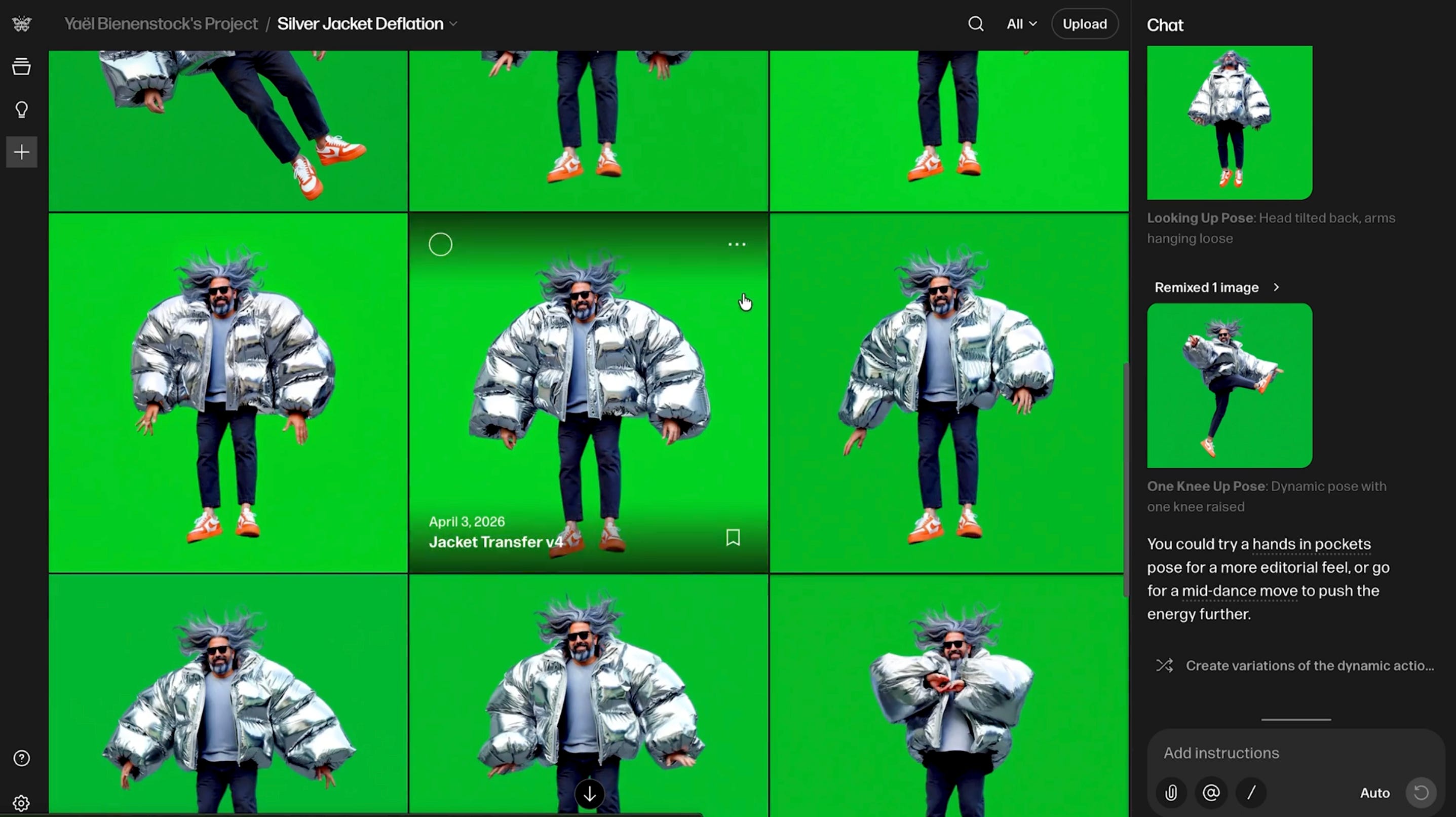
To build an animated character whose puffer jacket expands and transforms with every click, she used a mix of generative AI tools (Krea, Midjourney, Gemini, Rive) to create different parts of the animation before stitching everything together in After Effects and bringing it into Claude. The process is deeply iterative, with each tool contributing a different piece of the final result. “You cannot have a perfect output, and that’s totally fine. Knowing that this is not where it ends – that was a huge unlock for me.”
When designers resist new workflows because their existing ones feel faster, Katarina encourages them to accept slowing down for a while so they can speed up later: “You will make quantum leaps if you take the time to actually learn these new tools.”
But there’s one important caveat: don’t become obsessed with tools themselves. “I worry a little bit about function following form,” she says. “There’s so much discourse around what tools are in fashion this week versus next week. The problem is we risk losing connection with the questions we’re trying to answer and the people we are building software for.”
Get closer to the product
Katarina looks for two essential qualities in designers: “I’ve always wanted to hire designers who are deeply passionate about getting their things built, and who genuinely care about how they impact the business.”
While neither is unique to this moment in time, what’s different now is how much more feasible it is to meet those bars. “It’s never been easier to hop on and start contributing to code, even if you’re not technical.”
On the other hand, Katarina says, “designers who come from an era where their careers have been dedicated to execution…that might be a little bit narrow of a scope for where design is going.”
Today, designers can query Shopify’s data warehouse or search years of merchant interviews and support logs directly from the command line. They no longer have to wait on other teams to answer many of the questions that shape product decisions, giving designers a more direct role in understanding both users and the business.
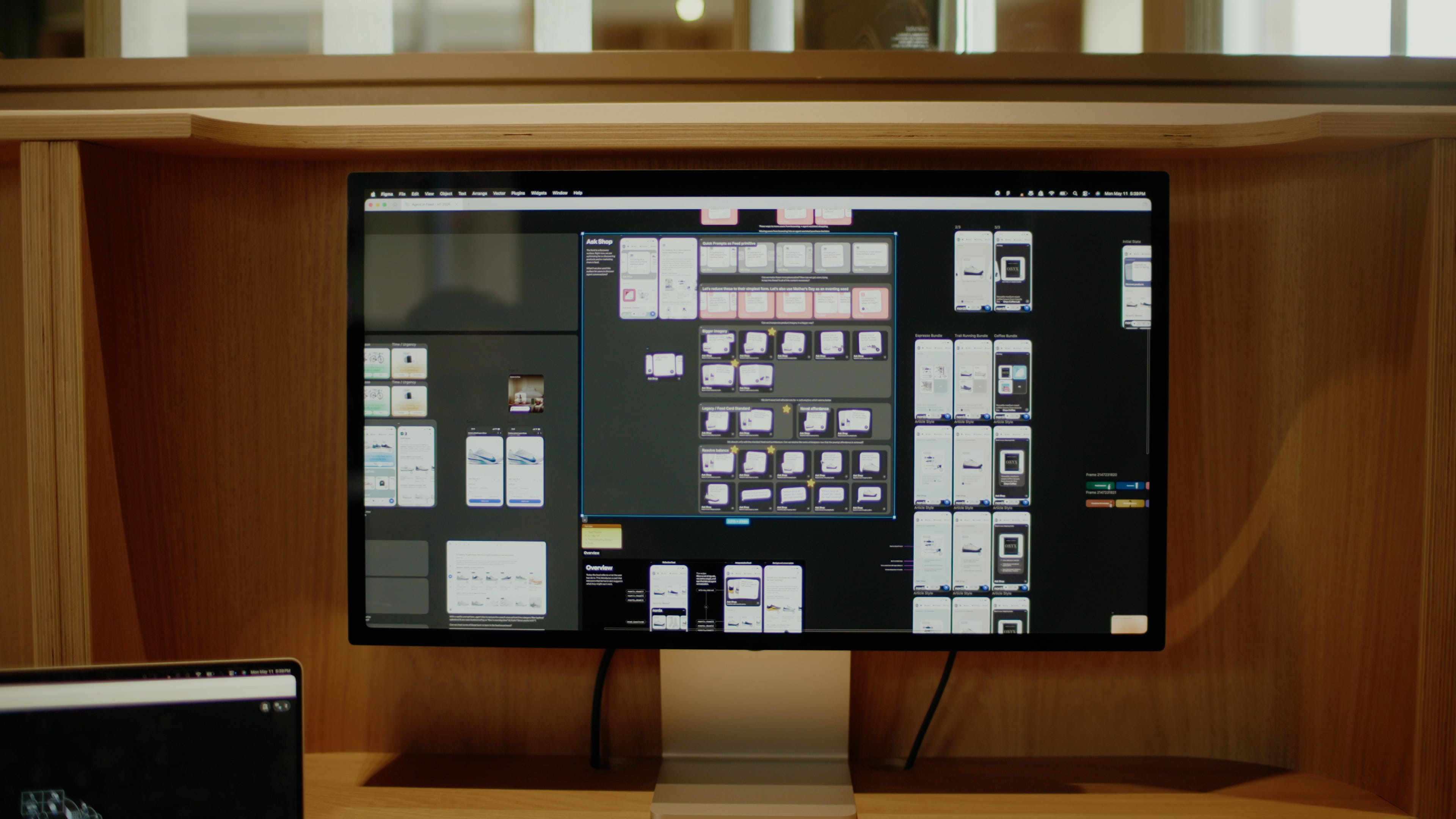
Taylor Cottrell, a Design Apprentice working on Shop, experienced that shift when designing a new agentic feed experience. He started by dropping an engineering document into Shopify’s LLM proxy to grasp the underlying system constraints – latency, lazy loading, deduplication, and card selection logic. Instead of discovering these technical boundaries late in the process, they became foundational inputs to the design itself, changing how he worked with engineering.
“Engineers felt that I had gone more than halfway across the table to understand what they were dealing with, and it made them more open to the stuff that we ended up presenting,” Taylor notes.
Ultimately, he wanted to understand the underlying system well enough to make better design decisions.
Learn alongside other designers
Beyond individual workflows, AI is fundamentally changing how designers collaborate.
What used to be a shared Figma file is now scattered across local codebases and AI-enabled prototypes. Reviewing a design is no longer as simple as opening a link, requiring teams to be far more intentional about how they work together.
To keep designers connected, Shopify built custom internal tools that bridge the gap. Quick lets anyone host and share a live prototype via link, while Artifact serves as the central hub for internal design work.
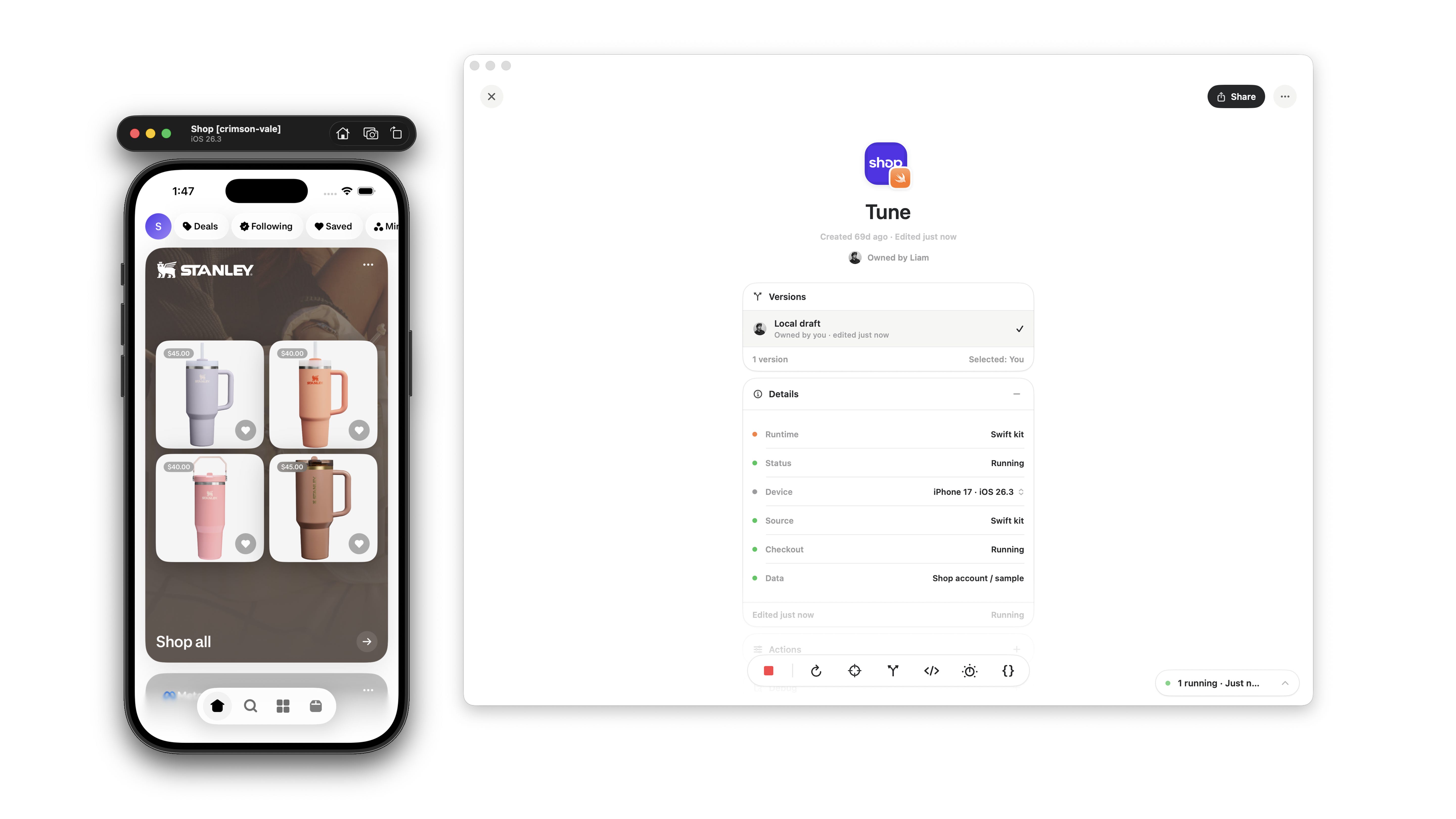
Senior Product Designer Liam Fennell built Purl, a one-click tool that spins up a real Shop client in React Native, Swift, or Expo, letting non-technical designers prototype directly within the production codebase without ever touching a terminal.
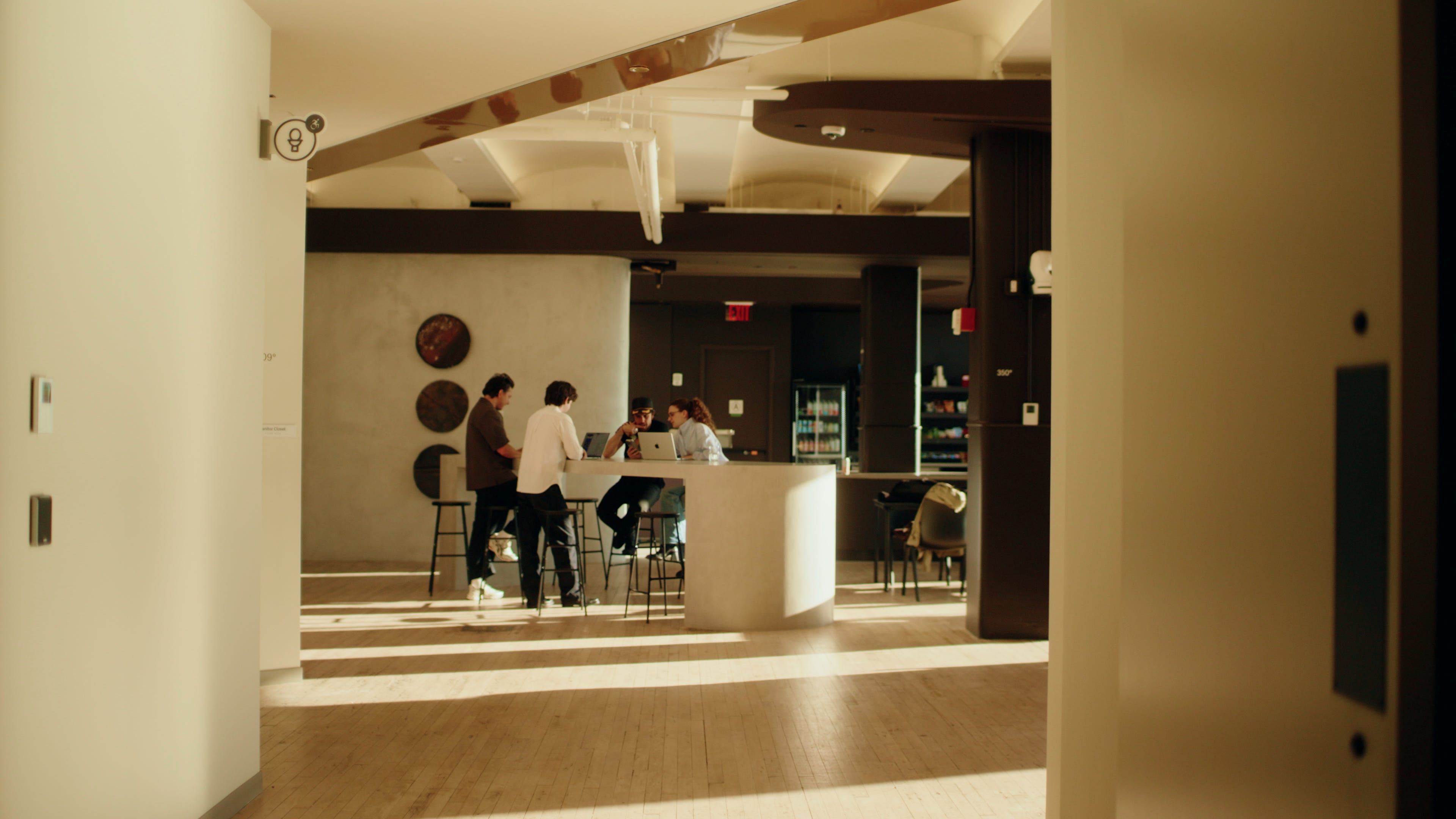
Yet even the best tools cannot replace the experience of sitting next to other designers and shipping things together. This is especially true for early-career designers, in a time when industry-wide hiring for junior roles is shrinking and expectations of new hires are rising. Shopify is doubling down on that kind of in-person learning with its newly opened Design Studio in New York, a beautifully designed space where designers work side by side.
Shopify’s Design Apprenticeship Program (DAP) is one way the company is addressing this problem. The six-month program places a small cohort of junior designers on product and brand teams, pairs them with experienced mentors, and has them work on real, shipped projects. The idea is simple: designers grow fastest by learning alongside other great designers.
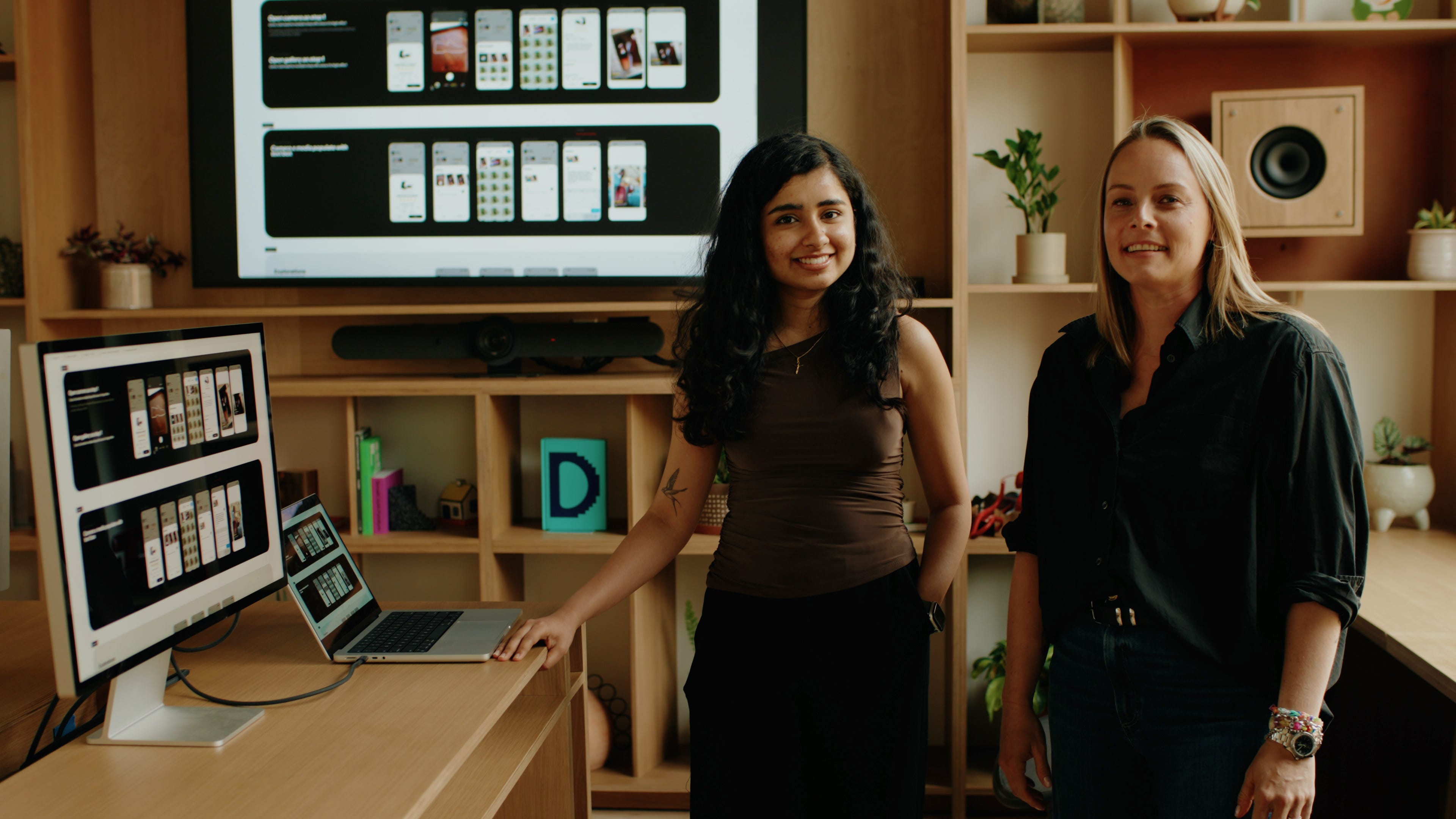
For Katarina, that belief is deeply personal. In 2012, she landed an internship at Facebook with almost no software experience because a group of designers looked past her resume and saw potential.
“That three-month internship changed the entire trajectory of my career. I credit that experience so much with where I am today, and I’m in a position now where I can hopefully extend the same kind of opportunity.”
As AI raises the ceiling for designers across the board, programs like DAP help answer an increasingly important question: how will the next generation get the experience that shapes great designers?
What all this means for designers
The technology will continue to change. New workflows will emerge, and the definition of a “designer” will keep evolving.
What remains constant, however, is the mindset that drives growth: stay curious, stay close to the product, and keep learning from the people around you. AI may be changing how design gets done, but at Shopify, it is ultimately reinforcing a timeless truth: the best designers have always been the ones who never stop growing.
“This era will really belong to the people who are most generative and whose creative ambition keeps moving as high as the tools will allow them,” says Katarina.
Shopify is hiring designers. See what the team’s shipped so far, learn about their design philosophy, and explore opportunities to join the team at shopify.design.
What we’re reading
A better front door for founders. We launched a new Designer Fund application for founders who may not have a warm intro. Every application is reviewed by our team alongside Mason, our AI agent trained on more than a decade of our investment decisions, and every founder receives tailored feedback.
AI usage patterns in software teams. Drawing on activity across tens of thousands of teams, Linear’s first How Teams Build report finds that AI adoption has more than doubled across every function, AI now authors nearly half of all issues, and pull requests per workspace have risen 111% in two years.
Founder-market fit as a compass. In our latest Designer Founders interview, Paper founder Stephen Haney shares how he chose a problem he’d be happy working on for years, hires people into their dream jobs, and is building a design tool that keeps humans in the driver’s seat while giving agents a canvas they can edit.
How do you design memory for an infinitely diverse user base? The latest AI Design Field Guide speaks with Benjamin Zweig, one of OpenAI’s first designers, about the process behind designing Memory for ChatGPT and making a complex capability feel simple and intuitive.
Featured roles
Euclid Power is hiring a remote Staff Product Designer to shape software for renewable energy project development and operations. The role is open across the U.S. and offers a base salary of $185–230k. Learn more and apply.
Ambrook is hiring a Brand Designer to help shape how its financial software for independent businesses shows up across campaigns, launches, storytelling, and the product itself. The role is open in New York, Denver, San Francisco, or remote. Learn more and apply.
Gusto is hiring an AI-native Design Systems Product Designer for Workbench, the internal system used by its designers and engineers to ship with AI assistance. It’s also looking for a People Partner to support its Product and Design organizations. Both are hybrid roles, with the design position open in SF, NYC, and Denver. Explore the design role or People Partner role.
Framer is hiring a remote Motion Designer to take ads and product videos from concept through animation, editing, sound, and final export. They’re looking for deep After Effects expertise, strong visual judgment, and experience with Framer or web design. Learn more and apply.
Stripe is hiring Product Designers across Stripe and Link for teams exploring the future of money, finance, and payments. They’re especially interested in designers who care deeply about craft and quality and love to code. See Dan Nelson’s post and get in touch.
Fewer translations stand between judgment and consequence thanks to LLM tools. It’s redefining how we all operate; designers, engineers, and everyone in between.